
 Kevin
Kevin Think visiting the doctor is uncomfortable? Try touring a museum filled with preserved brains in jars, Civil War amputation tools, and Victorian medical contraptions that look like torture devices. Five American museums reveal just how rough medicine used to be, and they’ll make you appreciate your annual checkup a whole lot more.
- Historic medical museums across the U.S. preserve equipment and specimens that reveal the often brutal realities of 19th and early 20th century healthcare.
- Psychiatric research labs were built inside asylums, while collections of “quack” medical devices document both progress and past mistakes.
- Visitors can see actual autopsy rooms, surgical instruments from battlefield medicine, and devices marketed without any scientific backing.
When Psychiatry Meant Studying Dead Patients in an Asylum
On the grounds of what used to be Central State Hospital for the Insane in Indianapolis, you’ll find the Indiana Medical History Museum. Built in 1896, this place wasn’t your typical hospital building. A 150-seat teaching amphitheater inside the Old Pathology Building gave medical students front-row seats to autopsies performed on patients who’d died at the asylum. Doctors wanted to find physical causes for mental illness by examining brains.
Walk through the 19 rooms today and everything sits exactly where it was left. Original equipment still fills the autopsy room. Clinical laboratories contain bacteriology and chemistry research tools from over a century ago. Preserved specimens line the anatomical museum, mostly brains collected from autopsies done in the 1930s and 1940s. Each brain came with a clinical case description, though no other identification.
America’s oldest surviving pathology laboratory operates here. Medical students from nearby colleges would travel to watch surgeons work. Central nervous system syphilis was studied extensively because it was so common in facilities like this. Operations continued until the 1960s, long after most similar research centers had closed.

Philadelphia’s Cabinet of Medical Oddities
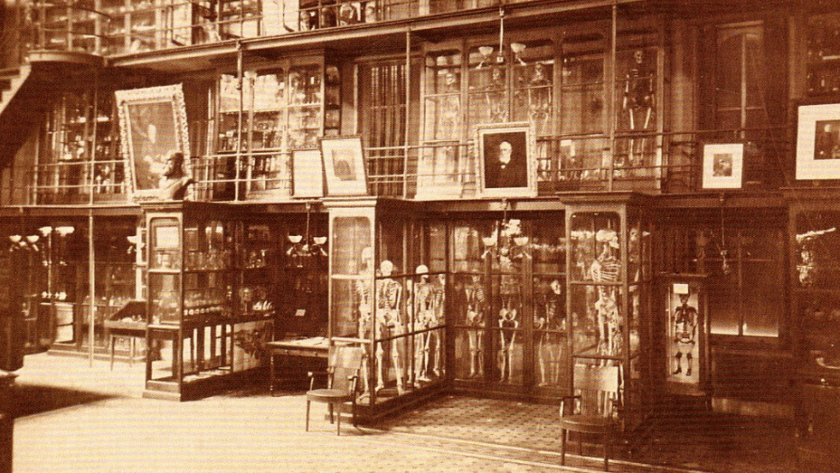
Over 25,000 specimens fill the Mütter Museum in Philadelphia. Think dense 19th-century “cabinet of curiosities” style. Rows of skulls line the walls. Skeletons twisted by disease stand next to preserved organs floating in jars of discoloring liquid. Wax models show disfiguring conditions in graphic detail.
Some memorable items include a 40-pound colon from someone who suffered chronic constipation, the shared liver of conjoined twins Chang and Eng, and the skeleton of a 7-foot-6-inch man. Visitors crowd around the “Soap Lady,” though not for happy reasons. Her body underwent a rare natural process called saponification after death.
Back in 1858, Dr. Thomas Dent Mütter donated his collection of over 1,700 specimens with strict conditions attached. Philadelphia’s College of Physicians had to build a fireproof building, appoint a curator, and keep expanding the collection. Visitor numbers have jumped from just a few hundred per year in the 1970s to over 60,000 annually.
Battlefield Surgery Without Modern Medicine
Frederick, Maryland’s National Museum of Civil War Medicine focuses on a particularly grim slice of medical history. Picture thousands of soldiers getting shot, sliced, or blown apart on battlefields. This museum tells that story without pulling punches.
Life-size scenes of field hospitals and amputations greet visitors, along with more than 1,500 original artifacts. Surgical kits from the era look primitive by today’s standards. Anesthesia existed, though it wasn’t always available. Sterilization wasn’t understood yet. Survival rates were terrible. No sugarcoating happens here.
Here’s what’s interesting about this place: it connects past and present. Many mass casualty protocols used today came from lessons learned during the Civil War. Plus, the building itself used to be an embalming station run by Dr. Richard Burr, who had a reputation for questionable business practices.
A Harsh Critique of Psychiatric Medicine in Hollywood
Los Angeles houses the Psychiatry: An Industry of Death Museum, which takes an entirely different angle. Run by the Citizens Commission on Human Rights, this museum was created to criticize psychiatric treatments. Electroshock therapy, restraints, and other interventions fill the exhibits, all described as harmful.
Thirteen mini-documentaries guide visitors through displays of psychiatric treatment devices and practices. You’ll get one clear message here: psychiatric medicine has caused damage throughout history. Whether you agree with this perspective or not, thousands of visitors show up to see this critique of mental health treatment.
When Gadgets Promised Miracle Cures
Bob McCoy spent years collecting bogus medical devices before donating over 325 items to the Science Museum of Minnesota. His collection became “Weighing the Evidence,” showing exactly what happens when marketing beats science.
Devices on display include phrenology machines that claimed to read personality through skull bumps, X-ray beauty treatments, and magnetic pain relievers. You’ll see a prostate warmer that plugs into a light socket. A foot-operated breast enlarger pump that left millions of women with sore tissue. Weight-loss glasses. Radium suppositories.
Here’s the scary part: quackery didn’t end in the 1800s. Some items in the collection were marketed as recently as the 1980s. Visitors learn how to spot medical misinformation today by looking at examples from the past.
Why The Mütter Museum—and Others Like It—Matter
Five museums preserving uncomfortable truths about medical history. Patients were treated in ways that look barbaric now. Some treatments were genuinely trying to help. Others were pure fraud. People at the time couldn’t always tell the difference.
Modern medical ethics, evidence standards, and patient protections came from learning what went wrong in these preserved rooms and devices. Today’s doctors operate under completely different rules, backed by science instead of guesswork or marketing hype.
Next time you dread a doctor’s appointment, remember this: at least they won’t be measuring bumps on your head or warming your prostate with an electrical device.
This post may contain affiliate links. Meaning a commission is given should you decide to make a purchase through these links, at no cost to you. All products shown are researched and tested to give an accurate review for you.