
 Kylie Whitcomb
 Most people don’t think of squirrels as pack animals capable of stampeding, yet in 1822, that’s just what they did. Learn everything you need to know about this strange historical event in Indiana.
Three years ago, parts of central Indiana celebrated a unique anniversary. September 2022 marked the 200th anniversary of the squirrel stampede of 1822.
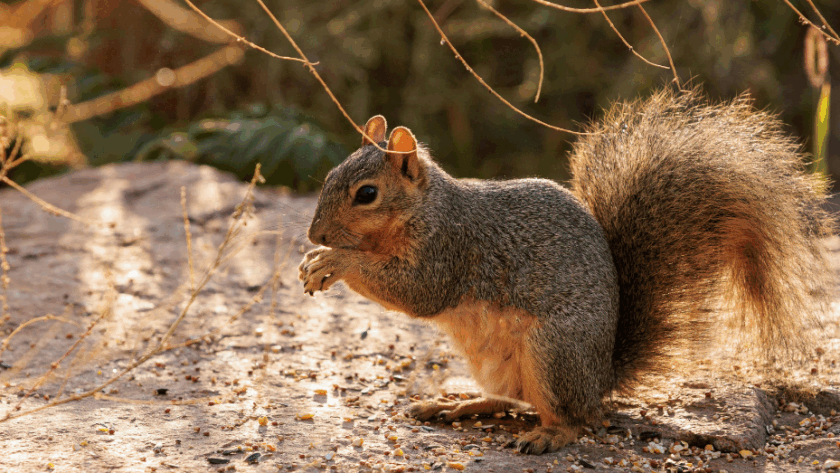
During the great squirrel stampede, Indiana was overrun by grey and black squirrels. They destroyed cornfields and other local crops and likely terrified the locals, who compared the stampede to a “bible locust swarm.”
How We Know the Great Squirrel Stampede Was Real
If you’re thinking this sounds a lot like a piece of obscure folklore, think again. We have proof that the squirrel stampede of 1822 truly happened in the form of a letter written shortly after the event occurred.
The letter was written by Calvin Fletcher, an Indianapolis banker, to his brother. In the letter, he describes a farmer who killed 248 squirrels in one field over three days and states his belief that every dozen squirrels ate through as much corn as a hog.
If you don’t believe Mr. Fletcher, there’s a second source of verification. Oliver Johnson also wrote a firsthand account of the squirrel stampede, including believable details. According to Johnson, so many squirrels died during the event that they attracted buzzards.
How the Squirrel Stampede of 1822 Passed Into Legend
Though the squirrel stampede is verified to have taken place, it’s also taken on a bit of a folkloric value. The event was first recorded in 1901 by a man named Augustus F. Shirts in A History of Hamilton County. He describes squirrels that would do anything, including ford rivers, to get to crops.
At the time of the squirrel stampede, the event would have been catastrophic for farmers. In 2022, central Indiana celebrated it with squirrel-themed events, public art installations, and even a scavenger hunt.
The 200th anniversary of the squirrel stampede drew public attention back to the event. The original stampede was recounted in numerous local papers, further solidifying its status as a local legend based on fact.
What Caused the Squirrel Stampede?
At the time of the squirrel stampede, Indiana was undergoing rapid deforestation. The Treaty of St. Mary’s passed in 1818 and set the stage for taking down much of the squirrels’ original habitat and turning it into corn fields.
The squirrels that ravaged those fields were part of a mass migration. Early naturalists attributed the migration to regular boom-bust food cycles, and modern scientists are inclined to agree. The squirrels were trying to move to a different part of the forest to find food, and instead, they found corn fields.
Smaller migrations occurred two other times in Indiana’s history. In 1842 and again in 1845, hundreds of millions of squirrels left home to seek out better forests for collecting acorns and other food. These smaller migrations weren’t destructive in the same way as the great squirrel migration of 1822.
This post may contain affiliate links. Meaning a commission is given should you decide to make a purchase through these links, at no cost to you. All products shown are researched and tested to give an accurate review for you.